
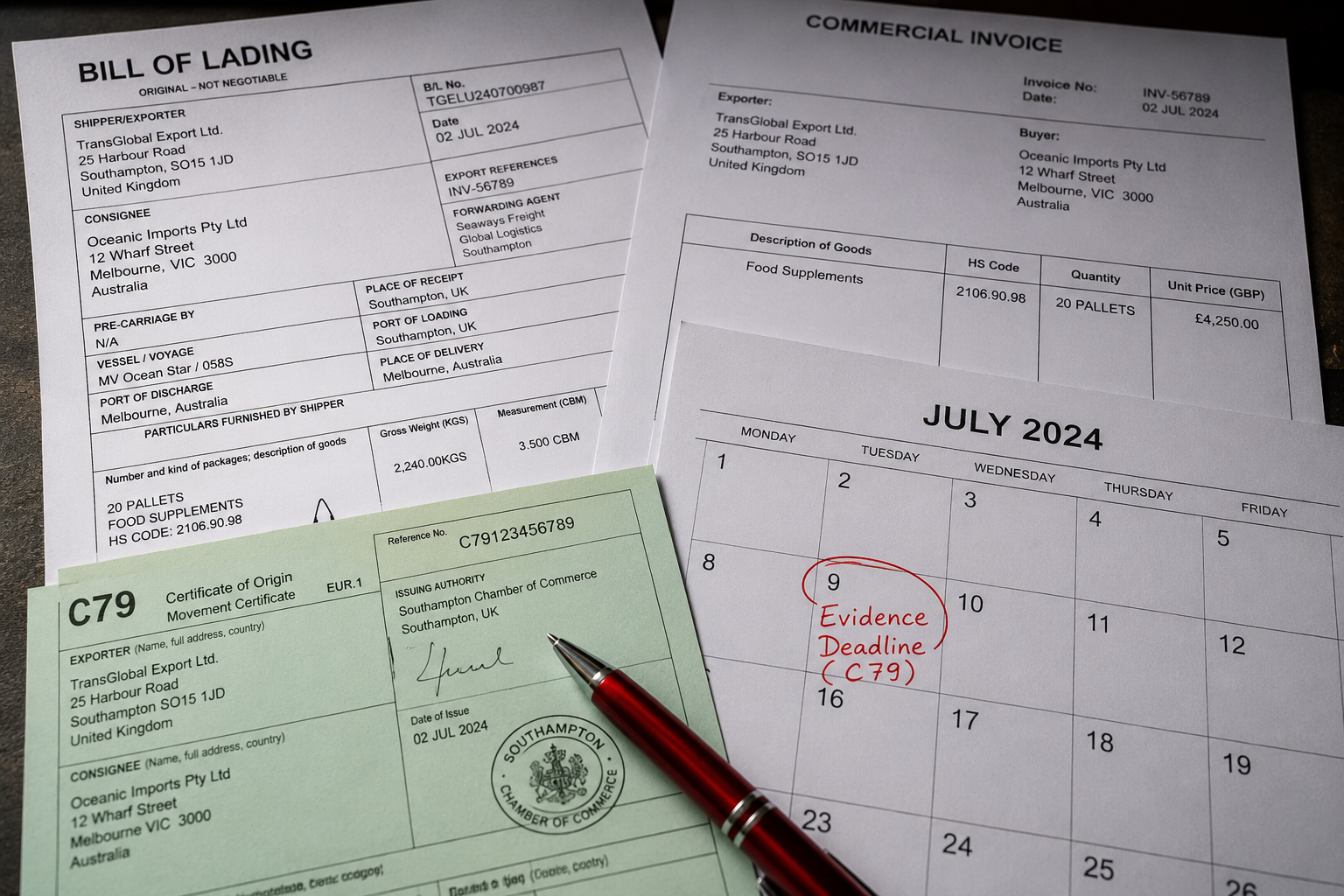
Somewhere between “we’ve just landed our first overseas order” and “why has HMRC written to us about that invoice from March,” a lot of small UK businesses discover that export VAT is not the formality they assumed it was. It sounds simple on paper — sell goods abroad, don’t charge VAT, done. Except it isn’t quite done, and the gap between “isn’t quite done” and “HMRC assessment landing on the doormat” is exactly where this article lives.
Export VAT, in the simplest possible terms, is the set of rules that let a VAT-registered business sell goods to customers outside the UK at 0% VAT instead of the standard 20%. That zero rate is a genuine tax advantage — but it’s conditional, not automatic, and the conditions trip up more businesses than you’d think. I’ve seen exporters lose the right to zero-rate a sale months after the goods left the country, purely because the paperwork wasn’t sitting in the right folder. So this is the article I wish more people read before, not after, their first export.
So What Does “Zero-Rated” Actually Mean?
Zero-rated is not the same as VAT-exempt, even though they look identical on an invoice (both show 0%). Exempt supplies sit outside the VAT system entirely, and you generally can’t reclaim VAT on costs linked to them. Zero-rated supplies, by contrast, are still within the VAT system — they’re taxable supplies, just taxed at nil. That distinction matters enormously for exporters, because it means you can reclaim input VAT on your related costs: packaging, freight, warehousing, the lot. Get this wrong on your VAT return and you’re either overpaying HMRC or underclaiming — neither is a great look.
Under current HMRC guidance, goods exported from Great Britain to a destination outside the UK, or from Northern Ireland to a destination outside the UK and EU, can be zero-rated for export VAT purposes, provided you obtain and retain acceptable evidence of export and meet the other conditions set out in VAT Notice 703. Miss the conditions, and the sale reverts to standard-rated VAT — retrospectively, if HMRC catches it on a compliance check.
(A quick aside: Northern Ireland sits in its own slightly odd corner of the export VAT world because of the Windsor Framework arrangements — goods moving from NI to the EU follow different rules from goods moving to the rest of the world. If your business ships out of Belfast rather than Bristol, don’t assume the mainland rules apply wholesale.)
Direct vs Indirect Exports — The Distinction Nobody Explains Well
This is where export VAT gets genuinely interesting, and also where most of the disputes with HMRC seem to originate.
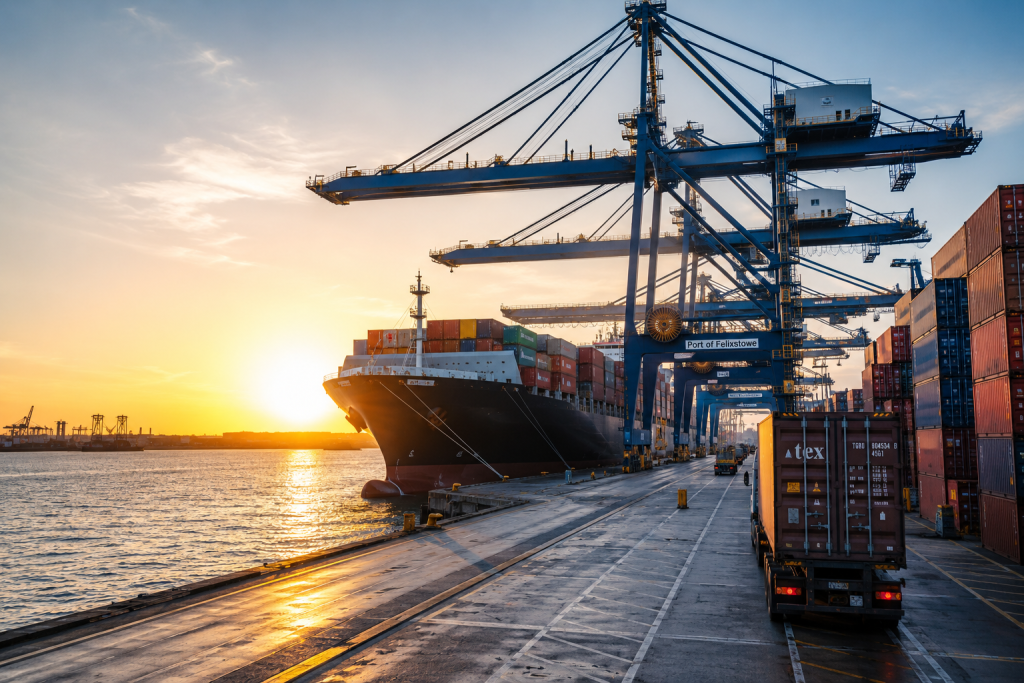
A direct export is one where you, the UK supplier, arrange for the goods to physically leave the country — you book the freight forwarder, you control the logistics, you’re the one holding the transport documents at the end of it.
An indirect export is one where your overseas customer arranges the transport themselves — collecting the goods from your premises, or instructing their own freight agent to do so.
Why does this matter? Because the evidence burden shifts depending on which one you’re doing, and because indirect exports have historically been the riskier category for zero-rating. There’s a genuinely fascinating 2024 tribunal case — Procurement International Limited v HMRC — where a company running corporate reward schemes shipped goods directly to individual recipients abroad, on behalf of UK-based client businesses. HMRC argued the domestic client relationship meant standard VAT should apply. The tribunal disagreed, confirming that a UK business can zero-rate an export even where the customer is UK-based, so long as the supplier controls the actual physical export of the goods. It’s a useful reminder that export VAT status hinges on where the goods go and who arranges that — not on who’s paying the invoice.
The Three-Month Clock (And Why It Catches People Out)
Here’s a detail that surprises almost everyone the first time they hear it: you generally have three months from the time of sale to obtain evidence that the goods have actually left the UK. Not three months to ship them — three months to have the paperwork proving they’ve gone. Sales get delayed at ports. Freight forwarders sit on documentation. Christmas happens. Three months evaporates faster than you’d expect when you’re not watching the calendar specifically for this purpose.
If that evidence window closes without the right documents, the default position is that the sale reverts to standard-rated VAT. You then owe HMRC the VAT you didn’t charge the customer — an unpleasant conversation to have with your finance team, and an even less pleasant one to have with a client who assumed the invoice was final.
What Counts as Evidence, Exactly?
HMRC splits acceptable evidence into two tiers, and you generally need at least one piece of official evidence plus supporting commercial evidence — not one or the other in isolation.
| Evidence type | Examples | Notes |
|---|---|---|
| Official evidence | Export declaration via the Customs Declaration Service (CDS); confirmation the transit procedure has been discharged | Generated through the customs system itself — the gold standard |
| Commercial evidence | Bills of lading, master air waybills, authenticated sea/air waybills, certificates of shipment | Split further into “primary” and “secondary” commercial evidence |
| Supporting evidence | Customer’s order, despatch note, inter-company correspondence, proof of payment | Shows a genuine supply took place — not just that a box moved somewhere |
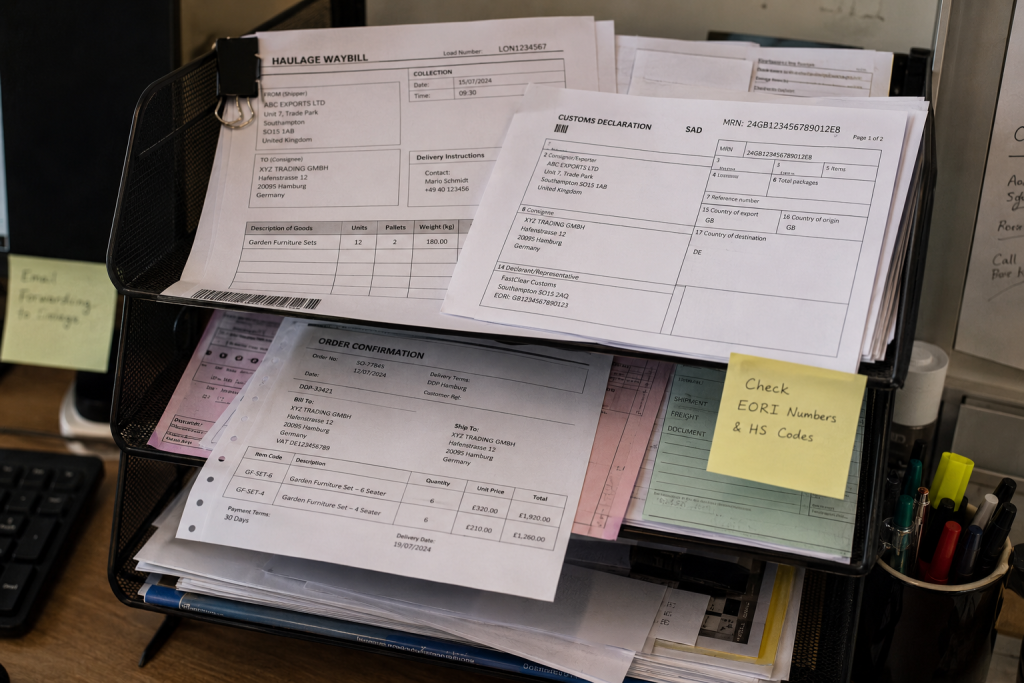
And a note on goods descriptions, because it’s the sort of thing that seems minor until an inspector flags it: vague wording like “various electrical goods” isn’t acceptable on export paperwork. HMRC wants specificity — quantities, product descriptions, values that tie back to the invoice. It’s tedious. It’s also exactly the kind of tedium that keeps your zero rate intact.
Services Are a Different Animal Entirely
Everything above concerns goods. Export VAT on services runs on a completely separate set of rules — place of supply rules, not the export evidence regime — and conflating the two is a classic mistake.
Broadly: services supplied to business customers (B2B) established outside the UK are usually treated as supplied where the customer belongs, meaning they fall outside the scope of UK VAT altogether. Not zero-rated, outside the scope, which is a meaningfully different VAT status with its own reporting implications. Services to consumers (B2C) abroad follow a messier set of exceptions depending on the type of service. If your business exports a mix of goods and services — software company shipping hardware and licensing a platform. Say — you may genuinely be applying two different rulebooks to two lines on the same invoice.
A Quick Reality Check on VAT Registration
You might assume that if every sale you make is a zero-rated export, you don’t need to bother registering for VAT at all. Sometimes that’s true. More often, it isn’t — because to zero-rate an export in the first place, you typically need to be VAT-registered as a UK-established business, and there are separate registration thresholds and rules that apply regardless of where your customers sit. This is one of those areas where a five-minute assumption can quietly cost thousands, and it’s worth working through properly rather than guessing. If you’re weighing up registration for the first time, it’s worth reading a broader guide to company VAT registration before your export volumes grow past the point where mistakes are cheap to fix.
Where This Usually Goes Wrong (In My Experience)
A few patterns come up again and again with exporting clients:
- Treating “the goods left the warehouse” as proof the goods left the UK. A despatch note isn’t export evidence on its own.
- Losing track of the three-month clock because it starts at the sale, not the shipment date, and those two dates aren’t always the same.
- Assuming EU sales still work like pre-2021. They don’t. Since Brexit, EU sales are exports like any other destination, not intra-community dispatches, and the old distance-selling VAT regime for EU consumers no longer applies to UK sellers in the way it once did.
- Forgetting Northern Ireland is different. NI-to-EU movements still sit closer to the old single-market rules; NI-to-rest-of-world follows the export regime.
- Not reclaiming input VAT they’re entitled to. Because export VAT is zero-rated, not exempt, the VAT on your shipping costs, packaging, and related expenses is still reclaimable — plenty of businesses simply don’t claim it.
None of these are big problems. They’re ordinary bookkeeping gaps that only become expensive when HMRC opens a review — which, worth flagging, is a genuinely more common experience than most business owners expect. If that’s ever happened to you, it’s worth understanding how HMRC tax investigations actually unfold before you’re in the middle of one.
Building an Export VAT Process That Doesn’t Rely on Memory
The businesses that handle export VAT cleanly tend to share one habit: they don’t leave it to memory. They have a checklist — sale date logged, evidence requested from the freight forwarder immediately, documents filed against the invoice number, a review before the three-month mark. Cloud accounting software makes this dramatically less painful than it used to be, largely because it can flag outstanding export evidence automatically rather than relying on someone remembering three months later. It’s one of the quieter but more valuable reasons businesses move away from spreadsheets — see our thoughts on why London businesses are making the switch to cloud accounting if that’s a decision you’re still sitting on.
For businesses already registered and trading internationally, keeping export VAT correctly reflected in quarterly returns matters just as much as the initial zero-rating decision — a broader look at VAT accounting compliance for UK businesses covers how that fits into the wider return process, including under Making Tax Digital.
At Ask Accountants UK Ltd, we handle a fair number of these cases precisely because export VAT sits at the intersection of two things people don’t enjoy: customs paperwork and tax law. Between our VAT accounting compliance, bookkeeping, and Cloud Accounting services, most of the client conversations start the same way — “we didn’t realise the evidence had to be this specific.” If that sounds familiar, it’s worth a conversation before your next export shipment rather than after HMRC’s letter arrives.
Export VAT: Frequently Asked Questions
Do I charge VAT on goods I export outside the UK? No — provided the conditions for zero-rating are met, you charge 0% VAT and show this clearly on the invoice, rather than the standard 20% rate.
What happens if I can’t get export evidence in time? The sale generally reverts to standard-rated VAT, meaning you may owe HMRC the VAT amount even if you never charged the customer for it.
Is export VAT the same as VAT exemption? No. Zero-rated supplies remain within the VAT system and allow input VAT recovery on related costs; exempt supplies generally don’t.
Do the export VAT rules apply the same way to Northern Ireland? Not entirely — NI-to-EU movements are treated differently from NI-to-rest-of-world exports, reflecting Northern Ireland’s post-Brexit trading arrangements.
Can I reclaim VAT on costs related to my exports? Yes. Because export VAT sales are zero-rated rather than exempt, input VAT on directly related costs such as freight and packaging remains reclaimable.
Do export VAT rules cover services as well as goods? No — services follow separate place of supply rules rather than the goods export evidence regime, so the two shouldn’t be treated as interchangeable.