

If you own rental properties in your personal name, you have likely felt the squeeze lately. Rising mortgage rates, Section 24 finance restrictions, and higher Self Assessment bills are tough to manage. Many UK landlords now ask the same question: should I move my portfolio into a limited company?
Before you sign anything, you need a clear grasp of property incorporation tax. Moving properties into a company you own is not a simple paperwork switch. HMRC treats the move as a full disposal and purchase at open market value. Without careful planning, that single step can trigger steep upfront charges.
We speak to stressed landlords and SME owners across London every week. Many feel trapped between two difficult options. Staying personally owned often means paying higher-rate Income Tax on profits you never fully see, because mortgage interest is no longer fully deductible.
Yet transferring property to a limited company without modelling the figures first carries real financial risk. You could face unexpected Capital Gains Tax (CGT), Stamp Duty Land Tax (SDLT), and refinancing fees. With clear numbers and the right timing, you can make a smart choice that protects your cash flow.

The Core HMRC Rules Behind Property Incorporation Tax
When you move personally owned rentals into a buy-to-let limited company you control, UK tax law classifies you and the company as “connected persons.” Because you are connected, HMRC ignores any nominal figure on a transfer deed. Instead, HMRC assesses the transfer at full open market value on the completion date.
Understanding how three core taxes interact is essential for managing property incorporation tax effectively.
1. Capital Gains Tax and Section 162 Incorporation Relief
Because HMRC treats the transfer as a market-value sale, any growth in property value creates a chargeable gain. You can deduct your original purchase costs, selling costs, and qualifying capital improvements. If you owe CGT on UK residential property, you must report and pay it within 60 days of completion through the GOV.UK Capital Gains Tax on UK property service.
Landlords running a substantial, active letting business may qualify for Section 162 incorporation relief. Under the Taxation of Chargeable Gains Act 1992, this relief lets you defer CGT by rolling the gain into your new company shares. HMRC outlines the strict tests in its Capital Gains Manual CG65700. You must transfer the entire business as a going concern, including all assets except cash, in exchange for shares.
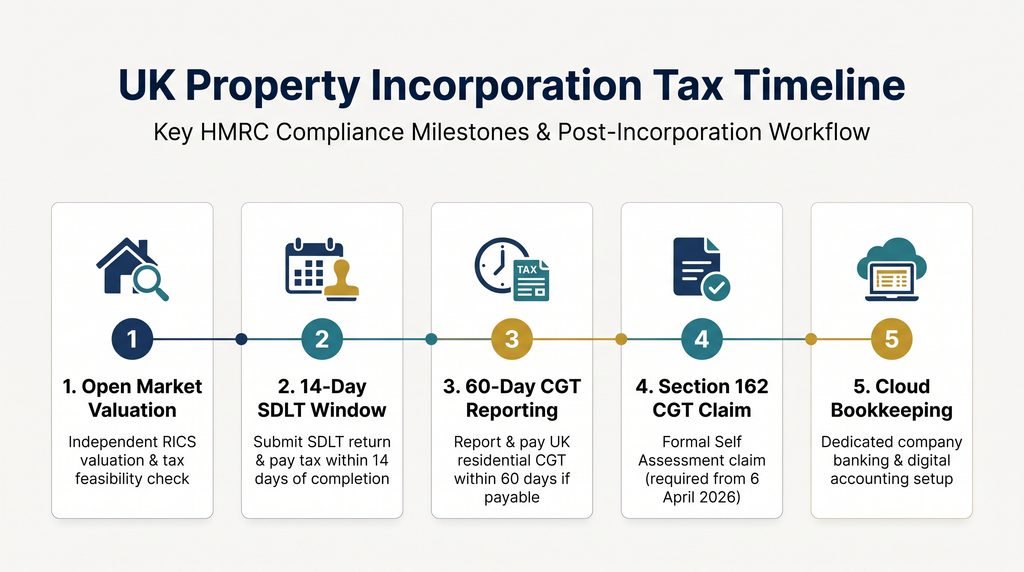
Watch out for a major 2026 rule change. For transfers on or after 6 April 2026, HMRC no longer applies Section 162 incorporation relief automatically. Per GOV.UK guidance on the Incorporation Relief claims process, you must now file a formal claim on your Self Assessment return. If you miss that claim, you could face an immediate CGT bill.
2. Stamp Duty Land Tax on Company Transfers
In England and Northern Ireland, your limited company normally pays Stamp Duty Land Tax on the market value of each transferred property. You can review the core transfer rules in GOV.UK guidance on transferring ownership of land or property. Companies buying residential property also generally pay the higher SDLT rates for additional dwellings. For a single flat or small portfolio, that upfront bill can wipe out years of future tax savings.
Schedule 15 of the Finance Act 2003 offers a specialist route for genuine, established property partnerships. When a real partnership incorporates into a company connected with the partners, SDLT relief may reduce or remove the charge. However, HMRC examines these arrangements very closely. You cannot simply form a partnership overnight to sidestep Stamp Duty. The partnership must show real commercial substance, joint management, and proper partnership accounts over a meaningful period.
3. Corporation Tax vs. Personal Income Tax
So why do landlords still explore transferring property to a limited company? Inside a company, your rental profits fall under Corporation Tax rather than personal Income Tax. Under current GOV.UK Corporation Tax rates, companies with profits of £50,000 or less pay the 19% small profits rate. Companies earning over £250,000 pay the 25% main rate, while profits in between qualify for Marginal Relief. Remember that associated companies divide these thresholds.
A buy-to-let limited company can also normally deduct 100% of allowable mortgage interest before calculating taxable profit. Individual landlords only receive a restricted 20% basic-rate tax credit. If you plan to reinvest profits to grow your portfolio, a company structure often improves cash retention. If you need to draw every pound personally each year, factor in dividend tax or PAYE first. Combining corporate tax planning with personal tax planning gives you the true net result.
Property Incorporation Tax Deadlines You Must Track
Missing a statutory deadline adds avoidable cost and stress to your property incorporation tax plan. Keep these key dates in front of you:
- SDLT returns and payment: File the SDLT return and pay any tax due within 14 days of completion. GOV.UK guidance on paying Stamp Duty Land Tax confirms this strict 14-day window.
- CGT on UK residential property: If you owe CGT on a residential transfer, report and pay it within 60 days of completion.
- Corporation Tax and Companies House: Your new company must file annual accounts with Companies House and a CT600 return with HMRC. You must pay Corporation Tax 9 months and 1 day after your accounting period ends. Check our guide to HMRC corporate tax return penalties for a full breakdown.
Making Tax Digital (MTD) and HMRC Penalty Rules
Digital record-keeping now sits at the heart of UK tax compliance. Most VAT-registered businesses must follow Making Tax Digital for VAT rules, though limited exemptions apply. From 6 April 2026, most sole traders and landlords with qualifying income over £50,000 must also use GOV.UK Making Tax Digital for Income Tax. Limited exemptions exist, including for people who are digitally excluded. Read our guide on Making Tax Digital for landlords to see how quarterly updates affect your personal portfolio.
Late payments carry clear financial consequences, so plan your cash flow early. HMRC charges late-payment interest from day 1 on overdue tax. Under HMRC’s harmonised penalty regime (covering VAT and Making Tax Digital for Income Tax penalties), first penalties arise at day 15 and increase at day 30. You can read the full mechanics in GOV.UK interest harmonisation guidance. Paying on time, or agreeing a payment plan promptly, protects your margins.
Common Errors and Record-Keeping Risks in Property Incorporation Tax
Even seasoned landlords make avoidable mistakes when managing property incorporation tax without a coordinated plan. Rather than treating these errors as automatic triggers for an enquiry, view them as common errors and record-keeping risks. Addressing them early saves money and prevents messy rework.
1. Assuming Every Landlord Qualifies for Section 162 Incorporation Relief
Many landlords assume that owning two or three rental flats counts as a “business” for Section 162 incorporation relief. HMRC draws a firm line between passive property investment and an active property business. To qualify, you usually need to show substantial, regular, and organised work that you carry out yourself. Handing everything to a letting agent rarely meets that bar.
Since 6 April 2026, you must also make a formal claim on your Self Assessment return. Keep clear logs of the hours you spend managing tenants, coordinating repairs, and overseeing portfolio finances. Without strong evidence, HMRC may challenge your claim and issue an unexpected CGT bill.
2. Overlooking Mortgage, Valuation, and SDLT Cash Flow Costs
Some landlords focus solely on long-term Corporation Tax savings and underestimate upfront friction costs. Transferring property to a limited company changes the legal owner of the title. Because of that, you must usually redeem your personal buy-to-let mortgages and arrange new limited company loans.
Refinancing can bring early repayment charges, arrangement fees, legal costs, and slightly higher interest rates. Skipping an independent RICS valuation creates another major record-keeping risk. If HMRC queries the market value behind your property incorporation tax figures, a casual estate agent estimate rarely holds up.
3. Blurring Personal and Company Finances After Incorporation
Your new buy-to-let limited company is a separate legal person. Treating its bank account like your personal current account is one of the most frequent record-keeping risks we see. Taking rent straight into your personal bank without recording dividends, salary, or a director’s loan account can create unexpected Section 455 tax charges.
Take the same care with company expenses. Directors regularly ask about claiming business entertainment or company vehicles through their property company. The rules on business entertainment and company vehicles are highly nuanced. Specific exceptions, Benefit in Kind rules, and partial VAT recovery rules depend on your exact circumstances. You can explore one example in our guide to electric company car tax benefits. Always seek tailored advice before claiming these costs.
Step-by-Step Workflow to Manage Property Incorporation Tax
A clear, sequential process takes the guesswork out of property incorporation tax and keeps every filing on schedule. Use this seven-step workflow before you instruct a solicitor.
Phase 1: Valuation and Feasibility Checks
- Gather your baseline portfolio data: Collect original purchase prices, acquisition SDLT receipts, capital improvement invoices, mortgage balances, and early repayment terms.
- Commission independent market valuations: Instruct a qualified surveyor for each property so your CGT and SDLT calculations rest on solid evidence.
- Run a 5-year tax and cash flow model: Compare staying personally owned (including Section 24 and MTD) against incorporating (including SDLT, CGT, refinancing, and dividend extraction).
- Assess relief eligibility early: Check whether your letting activity qualifies for Section 162 incorporation relief. If you run a genuine partnership, review Schedule 15 SDLT rules too.
Phase 2: Execution, Filing, and Cloud Setup
- Coordinate your professional team: Align your Chartered Certified Accountant, property solicitor, and mortgage broker before exchanging contracts. Our setup a company service structures your shares and SIC codes properly for specialist lenders.
- File every statutory return on time: Confirm your solicitor submits the SDLT return and payment within 14 days. File any 60-day CGT return promptly, and include your Section 162 claim on your Self Assessment return.
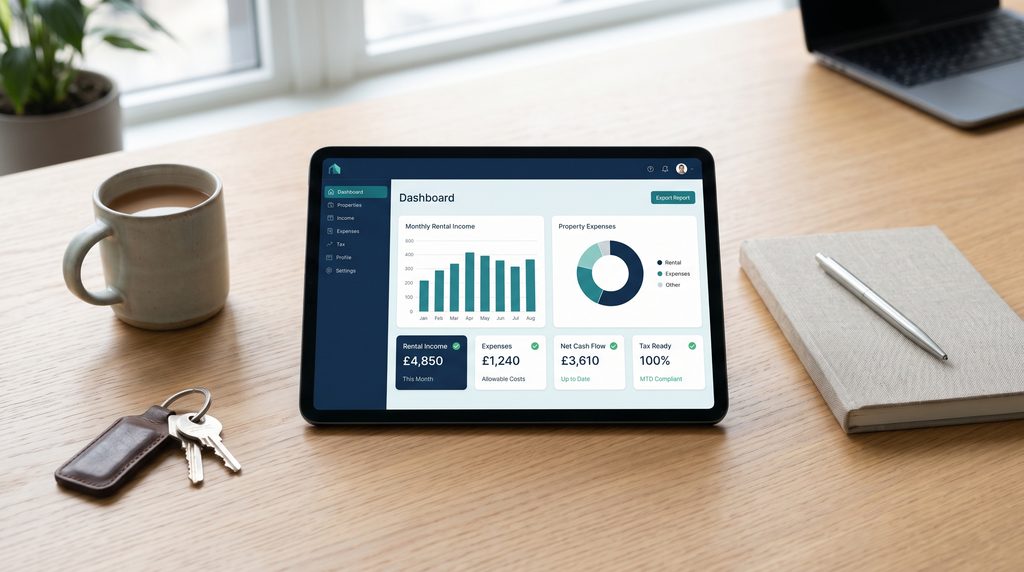
- Open company banking and cloud software: Set up a dedicated company bank account and connect it to Xero’s landlord accounting platform or QuickBooks UK. Our guide on QuickBooks for landlords in the UK helps you structure your chart of accounts cleanly.
Why Outsourcing Property Incorporation Planning Is a Smart Investment
Managing tenants, repairs, safety certificates, and mortgage renewals already fills your calendar. Trying to decode property incorporation tax rules, SDLT legislation, and company filings late at night adds needless stress.
Outsourcing your property accounting and tax compliance to an experienced Chartered Certified Accountant pays dividends in peace of mind. Professional support can reduce administrative burden, helps improve accuracy across your valuations and HMRC filings, and mitigates the risk of errors.
Pairing expert advice with cloud accounting services and regular bookkeeping support gives you real-time visibility over yields and tax liabilities. If HMRC ever questions a valuation or relief claim, our team handles HMRC investigations and compliance checks calmly and thoroughly.
Talk to ASK Accountants UK Ltd in Wimbledon
At ASK Accountants UK Ltd, we bring 15 years of experience supporting SMEs, founders, and landlords across Wimbledon and South-West London. We explain complex UK tax rules in plain English, with zero jargon.
Whether you let two flats in Merton or manage a larger London portfolio, our Chartered Certified Accountants will model your exact property incorporation tax position first. We handle feasibility reviews, Self Assessment returns, limited company formation, cloud bookkeeping, and ongoing Corporation Tax planning.
Ready to see whether incorporating your portfolio makes financial sense?
- Call our Wimbledon team today: 020 8543 1991
- Visit our office: 178 Merton High St, Wimbledon, London
- Book a consultation online: Contact ASK Accountants UK Ltd
Frequently Asked Questions About Property Incorporation
1. Do I always pay Capital Gains Tax when transferring property to a limited company?
Not always, although CGT is the starting point. HMRC treats a transfer to your own company as a market-value sale. If you run a genuine, active property business and transfer the whole business for shares, Section 162 incorporation relief may defer the gain. For transfers from 6 April 2026 onward, you must actively claim this relief on your Self Assessment return, as explained in GOV.UK’s Incorporation Relief guidance.
2. Is a buy-to-let limited company always more tax-efficient than personal ownership?
No. The right structure depends on your Income Tax band, mortgage leverage, and personal spending needs. Basic-rate taxpayers with small mortgages often save more by staying personally owned once they factor in SDLT, refinancing, and company accountancy fees. Higher-rate or additional-rate taxpayers with larger mortgages who plan to reinvest profits usually see the strongest benefits from managing property incorporation tax through a company.
3. Can I transfer one property from my portfolio and claim Section 162 incorporation relief?
No. Section 162 incorporation relief requires you to transfer the whole property business (all business assets except cash) to the company as a going concern. Moving just one property out of a larger portfolio disqualifies the claim, so HMRC will normally assess CGT on that disposal. Always take tailored advice before choosing between a partial or full transfer.