
Here’s a confession before we start: most directors don’t lose sleep over corporation tax rates. They lose sleep over the fact that they know something clever could be done with their money, but nobody’s ever explained it in a way that isn’t wrapped in fifteen layers of jargon. That’s what this piece is for. Tax efficiency for company directors isn’t about dodging anything — it’s about arranging your income, benefits and pension contributions so HMRC gets exactly what it’s owed and not a penny more. Simple in theory. Trickier once payroll, dividends, and a slightly nervous accountant get involved.
If you run a limited company — whether it’s just you and a laptop, or you’ve got a small team and a proper office — the way you extract money from your business shapes your personal wealth for years. Get it wrong and you’re quietly gifting HMRC extra cash every single year without realising. Get it right, and tax efficiency becomes less of an annual scramble and more of a habit.
Why Directors End Up Overpaying Without Noticing
Most overpayment isn’t dramatic. Nobody wakes up and decides to hand over an extra grand to the Exchequer. It happens in dribs and drabs: a bonus taken at the wrong time, a pension allowance left untouched, a spouse who could’ve been on the payroll but wasn’t. Multiply small inefficiencies across a few years and the number gets uncomfortable fast.
Directors of small and medium companies across London — Wimbledon, Merton, the wider SW postcodes — often run lean operations. There’s rarely a finance team double-checking every decision. That’s exactly where a bit of structured tax efficiency planning earns its keep, and honestly, it’s the kind of thing firms like Ask Accountants UK Ltd deal with daily through their Personal Tax Planning and Tax Compliance services.
Salary vs Dividends: The Argument That Never Really Ends
Ask ten accountants how a director should be paid and you’ll get eleven opinions. But the underlying logic of tax-efficient extraction usually boils down to this: pay yourself a small salary up to the National Insurance threshold (enough to protect your state pension record), then top up with dividends taxed at the (generally lower) dividend rates.
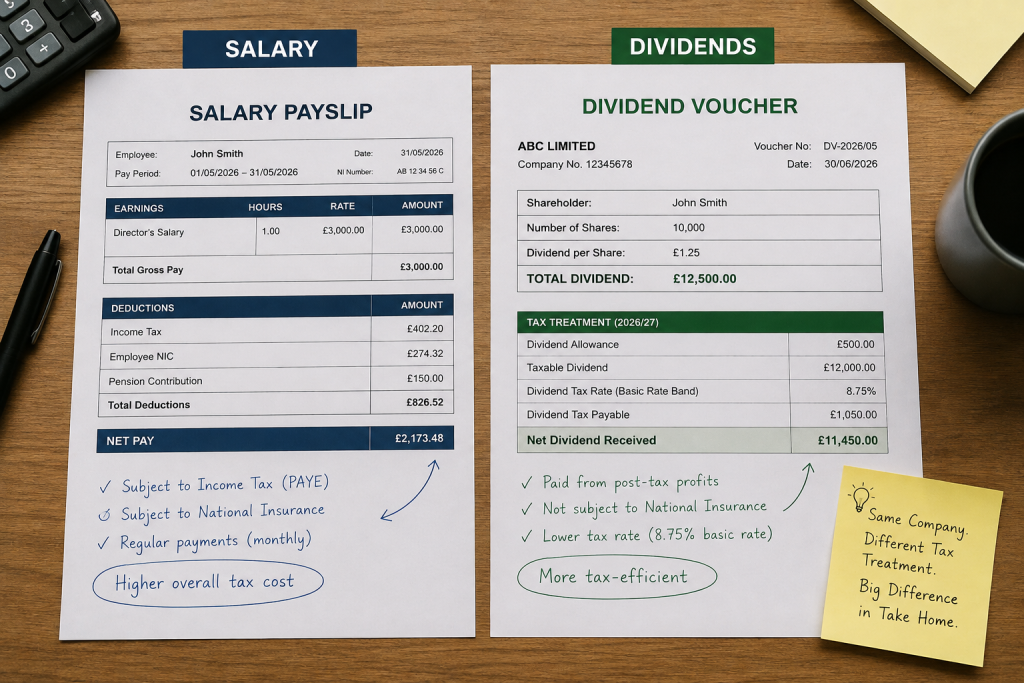
The current dividend allowance and rate bands change most tax years, so this isn’t a “set once, forget forever” strategy — it needs revisiting annually.
According to GOV.UK’s dividend tax guidance, dividend rates sit below equivalent Income Tax bands, which is precisely why this combination remains a cornerstone of tax efficiency for owner-directors.| Extraction Method | Taxed Under | National Insurance? | Typical Use Case |
|---|---|---|---|
| Salary (up to NI threshold) | PAYE / Income Tax | Protects state pension, minimal NI | Sole director, no other employees |
| Dividends | Dividend Tax | None | Topping up income efficiently |
| Pension contributions | Corporation Tax relief | None | Long-term, tax-deferred saving |
| Benefits in kind | P11D / Class 1A NI | Employer NI applies | Company car, healthcare, etc. |
There’s no single “correct” split — it depends on your other income, whether you’ve a spouse who could take dividends too, and how close you are to the higher-rate threshold.
Pensions: The Most Underused Tax Efficiency Trick in the Book
Pension contributions made by the company are one of the quietest wins in director tax planning. They’re deductible against corporation tax, they don’t attract National Insurance, and unlike a salary bump, they don’t push you into a higher personal tax band. And yet a striking number of directors leave this lever untouched, year after year, purely because nobody sat them down and explained it.
Annual allowance limits do apply, and they can taper for higher earners — details worth checking against. We’ve written more on this in The Ultimate Guide to Auto-Enrolment and the pension lump sum tax guide, both of which go deeper into the mechanics.
Quick reality check: A £10,000 employer pension contribution can save more in combined corporation and income tax than the same amount paid as a bonus. It’s not glamorous. It’s just maths.
Claiming What the Company Actually Owes You
Directors are sometimes strangely reluctant to claim legitimate expenses — as though asking “can I claim this?” feels a bit cheeky. It isn’t. Mileage, home office costs, training directly related to the business, subscriptions, even a portion of broadband if you genuinely work from home — these all chip away at taxable profit, and that’s tax efficiency doing exactly what it’s meant to do.

We put together a full breakdown in What Expenses Can a Limited Company Claim if you want the exhaustive version. The short version: keep receipts, keep a mileage log, and don’t guess at year-end — guessing is how legitimate claims get missed or, worse, overclaimed.
Timing Is Everything (Yes, Even With Tax)
Here’s something people rarely think about: when you take income can matter as much as how much. Deferring a dividend by a few weeks into a new tax year, bringing forward a large equipment purchase to use capital allowances sooner, or delaying a bonus until profits are confirmed — these timing decisions are where genuinely tax-efficient directors separate themselves from the rest.
Corporation tax rates and thresholds shift periodically too. Check the current bands directly via GOV.UK’s corporation tax page rather than relying on last year’s figures — this is one area where stale information costs real money. Our own guide on how to reduce corporation tax legally in 2026 walks through several of these levers in more detail.
Bringing Family Into the Picture (Carefully)
If your spouse or civil partner does genuine work for the business — admin, bookkeeping, marketing, whatever it may be — putting them on the payroll or making them a shareholder can spread income across two personal allowances instead of one. HMRC does scrutinise this (the “settlements legislation” is the phrase to Google if you want a headache), so the work needs to be real and the pay needs to be reasonable. Done properly, though, it’s a legitimate and fairly common tax efficiency strategy for family-run companies.
Common Reliefs Directors Forget About
| Relief / Allowance | Applies To | Roughly Worth |
|---|---|---|
| Annual Investment Allowance | Equipment, machinery | Up to £1,000,000 in relevant year |
| Employment Allowance | Employer NI | £5,000 |
| Business Asset Disposal Relief | Selling the company | 10% CGT rate on qualifying gains |
| R&D tax relief | Qualifying innovation work | Varies — often thousands |
That table’s a little rougher round the edges deliberately — real allowances shift year to year and the figures above are indicative, not gospel. Always confirm current thresholds before acting on them.
Thinking About Selling Up? Plan the Exit Early
Tax efficiency doesn’t stop the moment you decide to sell or wind down the business. Business Asset Disposal Relief (formerly Entrepreneurs’ Relief) can significantly reduce Capital Gains Tax on a sale, but only if certain conditions are met well in advance — not scrambled together the week before completion. If inheritance and succession planning are on your radar too, our guides on inheritance tax planning and reducing inheritance tax on family property are worth a read alongside this one.
Where Directors Go Wrong
A few patterns come up again and again:
- Leaving pension contributions until March, panicking, and either overpaying or missing the allowance entirely.
- Taking dividends without checking the company has distributable profits — a genuinely common and entirely avoidable mistake.
- Ignoring Benefits in Kind reporting, then getting an unwelcome letter from HMRC months later.
- Never reviewing the salary/dividend split once it’s set, even as personal circumstances change.
None of these are dramatic failures. They’re just habits that quietly erode tax efficiency over time.
FAQ: Tax Efficiency for Company Directors
What’s the most tax-efficient salary for a director in 2026? Most directors take a salary around the NI Secondary Threshold to protect state pension entitlement while minimising National Insurance, then supplement with dividends. The exact figure depends on personal circumstances and should be checked annually — thresholds move.
Are dividends always more tax-efficient than salary? Generally yes for directors above the NI threshold, since dividends avoid National Insurance. But it’s not universal — if you need to maximise pension contributions or mortgage-qualifying income, a slightly different mix might suit you better.
Can my company pay into my personal pension tax-efficiently? Yes. Employer pension contributions are typically deductible against corporation tax and aren’t subject to NI, making them one of the most efficient ways to extract value from a company long-term.
Is hiring an accountant worth it for tax efficiency planning? For most directors, yes — the reliefs and allowances change often enough that professional Business Advice pays for itself, particularly once profits climb past a modest threshold.
Where This Leaves You
None of this is about finding a loophole nobody’s heard of. Tax efficiency, done properly, is closer to good housekeeping than clever trickery — a salary set sensibly, dividends taken with an eye on thresholds, pension contributions treated as a serious tool rather than an afterthought, and expenses claimed without guilt. If you’d rather have someone run the numbers than second-guess them yourself, Ask Accountants UK Ltd at 178 Merton High St, London SW19 1AY can talk it through — 020 8543 1991, or browse their Personal Tax Planning and Tax Compliance services for a fuller picture.