
If you run a small business, manage a growing startup, or juggle a property portfolio in the UK, you already know how overwhelming compliance can feel. One of the biggest hurdles you will face is managing your PAYE Tax. It is not just about paying your staff. It is about navigating a complex web of HMRC regulations, strict deadlines, and constant updates.
Running payroll should be a moment to reward your team for their hard work. Instead, it often becomes a source of anxiety for business owners terrified of making a mistake. You are not alone in feeling this way. Countless founders and landlords lose sleep over tax codes and filing deadlines.
This guide is designed to cut through the confusion. We will break down the essential rules of the PAYE Tax system, highlight the most common pitfalls, and give you a clear workflow to keep your business on track.

The Core Rules of Managing Your PAYE Tax
Pay As You Earn is HMRC’s system to collect Income Tax and National Insurance contributions directly from an employee’s wages before they ever receive their pay. As an employer, you act as the collection agent for the government. This means the responsibility for calculating deductions accurately falls entirely on your shoulders.
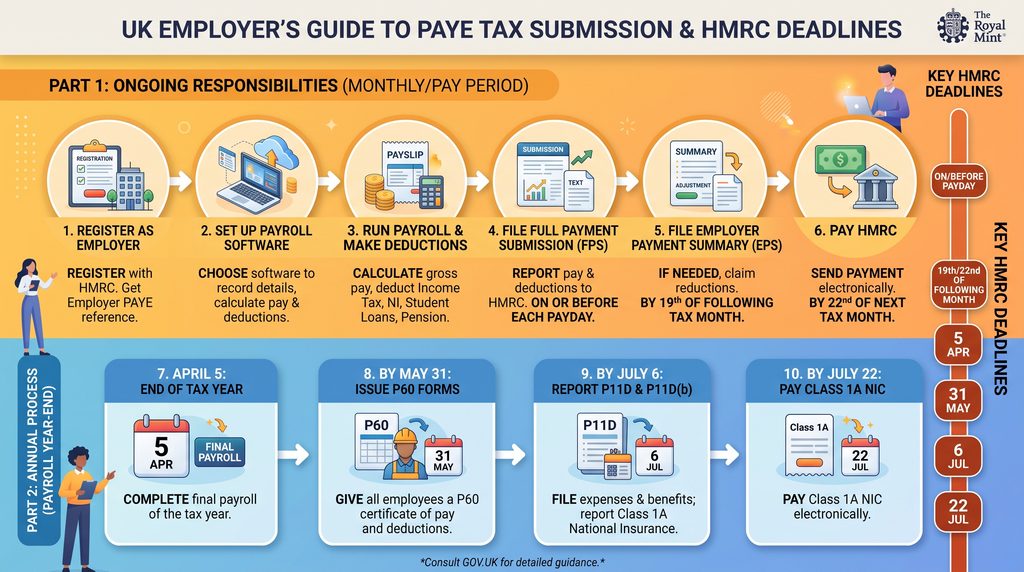
You generally need to register for PAYE with HMRC before your first payday. This applies if you are paying an employee at or above the lower earnings limit, providing expenses and benefits, or hiring someone who already has another job or receives a pension.
Understanding Key Thresholds and Deductions
Once registered, you must calculate and deduct the correct amounts every single time you run payroll. This includes basic Income Tax based on the employee tax code. It also includes employee and employer National Insurance contributions.
Depending on your workforce, you might also be responsible for deducting student loan repayments or handling pension auto-enrolment contributions. The math can get complicated very quickly. You must track all of this data securely and report it to HMRC on or before the day you pay your staff. This is done through a Full Payment Submission (FPS).
Strict Deadlines and HMRC Payments
Reporting the data is only half the battle. You also have to send the collected money to HMRC on time. If you pay electronically, your payment must clear HMRC’s bank account by the 22nd of the next tax month.
Missing this deadline has immediate consequences. This is not an area where HMRC offers much flexibility. You must have a robust system in place to ensure cash flow is available to cover these liabilities every single month.
The Impact of Making Tax Digital
The tax landscape is changing rapidly. You might already be familiar with Making Tax Digital for VAT. HMRC is now rolling out Making Tax Digital for Income Tax in phases starting from April 2026.
Most VAT-registered businesses and sole traders with qualifying income above specific thresholds will eventually need to keep digital records and submit quarterly updates to HMRC. While exemptions exist for digitally excluded individuals or those below the income thresholds, the vast majority of modern businesses will need to adopt compliant software. Upgrading your systems to dedicated cloud accounting platforms now will save you a massive headache later.
Common Errors and Record-Keeping Risks with PAYE Tax
Even well-intentioned business owners make mistakes. When you are rushing to get payroll out the door on a Friday afternoon, it is easy to miss a small detail. Unfortunately, these small details can lead to significant headaches down the line. Here are three common errors and record-keeping risks you need to watch out for.
1. Incurring HMRC Late Payment Penalties
Failing to pay your PAYE bill on time is one of the most common risks business owners face. Cash flow gets tight, and sometimes the HMRC payment gets delayed.
You must be very precise with your timing because HMRC late payment penalties escalate quickly. Late-payment interest begins accruing on day 1 after the missed deadline. If the balance remains unpaid, the first penalties arise at day 15. These penalties will then increase at day 30. We never want to use alarmist language, but it is vital to understand that ignoring a late payment will only make the financial burden heavier.
2. Mishandling Tricky Expenses and Benefits
Many directors try to run expenses through their company without fully understanding the tax implications. Two of the most misunderstood areas are business entertainment and company vehicles.
You might think taking a prospective client out for dinner is a simple business expense. However, the rules surrounding business entertainment are highly nuanced. There are strict exceptions and partial recovery rules depending on who attends the event and the primary purpose of the gathering.
Similarly, providing a company car or fuel allowance triggers specific reporting requirements and potential Benefit-in-Kind charges. Because these rules are so complex, readers should always review what business expenses a limited company can claim and seek specific advice from a qualified accountant before making assumptions about what is deductible.
3. Using Incorrect Tax Codes
Your payroll software relies on the tax codes you input. If an employee provides a P45 from a previous job, or fills out a starter checklist incorrectly, you might apply the wrong code.
Using the wrong tax code means you will either under-deduct or over-deduct tax from your employee. While this does not necessarily mean an immediate financial penalty for you as the employer, it causes massive frustration for your staff. An employee facing an unexpected tax bill at the end of the year because of a payroll error will understandably be upset. Always double-check tax notices issued by HMRC to mitigate the risk of errors.
Your Step-by-Step PAYE Tax Workflow
Having a repeatable workflow is the secret to managing payroll without the monthly stress. Follow this simple checklist to keep your processes clean and compliant.
- Step 1: Gather Accurate Data. Before you even look at your payroll software, ensure you have the correct hours, overtime rates, and expense claims for every employee. Do not rely on verbal confirmations. Keep written records.
- Step 2: Update Your Software. Ensure your chosen software is fully up to date with the latest HMRC tax rates and thresholds. Cloud-based systems usually update automatically.
- Step 3: Process New Starters and Leavers. Input any P45 data for new hires. Generate P45s for anyone who left your company during the month.
- Step 4: Calculate Deductions. Run the payroll calculation. Review the draft payslips to spot any obvious anomalies before finalizing the run.
- Step 5: Submit the FPS. Send your Full Payment Submission to HMRC on or before the day your employees receive their money.
- Step 6: Distribute Payslips. Provide your team with their payslips securely.
- Step 7: Schedule the Payment. Log into your business bank account and schedule the payment to HMRC so it clears well before the 22nd of the following month.
To make this workflow even smoother, we highly recommend integrating your payroll with a leading accounting platform. You can read more about setting up these systems on the official GOV.UK PAYE guidance page or by exploring Xero’s payroll features.
Why Outsourcing Your PAYE Tax Makes Sense
Managing payroll in-house is possible, but it drains a massive amount of your time. Your energy as a business owner should be focused on growth, customer service, and strategy. Spending hours every month wrestling with tax codes is not the best use of your skills.
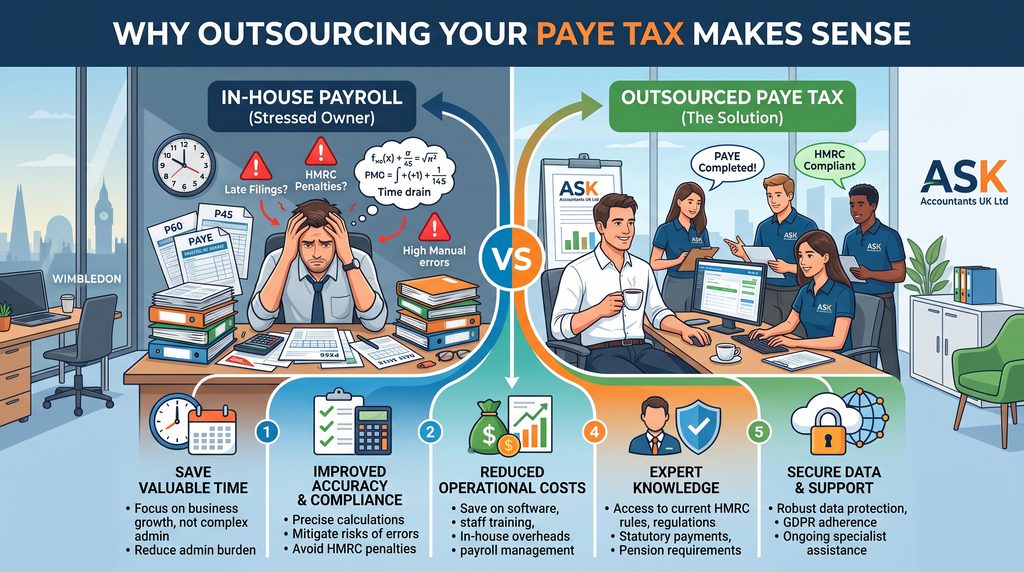
Outsourcing your payroll to a professional accountant can reduce administrative burden significantly. A dedicated professional understands the nuances of the legislation and stays updated on every minor HMRC change. Relying on small business accounting services helps improve accuracy in your calculations and mitigates the risk of errors that could lead to unexpected fines.
When you trust a professional with your payroll, you buy back your time and gain true peace of mind.
How ASK Accountants UK Ltd Can Help You
At ASK Accountants UK Ltd, we know exactly how challenging it is to run a business in today’s economy. Based in Wimbledon, we have spent 15 years helping SMEs, startup founders, and landlords across South-West London navigate the complexities of UK tax law.
We do not just crunch numbers. We partner with you to streamline your financial processes. Whether you need full payroll management, assistance with your upcoming digital transitions, or general tax planning, our experienced team is here to support you.
Do not let payroll stress hold your business back. Let us handle the compliance so you can focus on what you do best.
Ready to simplify your workload? Explore our Bookkeeping Service or reach out to our friendly team today. Call us directly at 020 8543 1991, visit us at 178 Merton High St, or click here to visit our Contact Page.
Frequently Asked Questions
What happens if I cannot pay my PAYE Tax bill on time?
If you miss the deadline, HMRC will apply late-payment interest starting from day 1. If the bill remains unpaid at day 15, the first penalty will be applied, and this penalty increases at day 30. If you know you cannot pay, you should contact HMRC immediately to discuss setting up a Time to Pay arrangement.
What is the difference between PAYE Tax and a Self Assessment tax return?
PAYE is the system used by employers to deduct tax from employee wages at the source. A Self Assessment tax return is used by individuals, such as sole traders or company directors, to report untaxed income to HMRC directly. Many business owners have to deal with both systems. You can learn more in our detailed Self Assessment tax return guide or check the official rules on GOV.UK.
Do I need to register for PAYE if I am the only employee of my limited company?
Yes. If you operate as a limited company and pay yourself a salary above the Lower Earnings Limit, you are classed as an employee of your own company. You must register as an employer and operate a compliant payroll system just like any other business.