
The cost of an accountant for a limited company is one of those questions that feels deceptively simple until you actually start asking around. You get one quote for £600 a year. Another for £3,500. And absolutely no explanation of why the difference exists. It’s maddening — and you’re not wrong to be confused by it.
Here’s what nobody tells you upfront: limited company accountant fees aren’t a fixed, universal number. They shift depending on the complexity of your accounts, how many transactions you rack up, whether payroll or VAT are involved, and — somewhat inconveniently — where in the UK your business happens to be based.
This guide cuts through the fog. Real numbers, real service breakdowns, and a few truths that don’t usually make it into the polished brochures.
Cost of Accountant for a Limited Company: The Real Numbers
Right, straight to it. For a basic, one-director limited company with modest turnover, clean records, and no employees, you’re typically looking at £600 to £1,500 per year for core accountancy services. That usually covers annual statutory accounts, your Corporation Tax return (CT600) filed with HMRC, and the Confirmation Statement submitted to Companies House.
But “basic” and “straightforward” are doing a lot of heavy lifting in that sentence.
The moment you add a payroll run, quarterly VAT returns, multiple directors, CIS subcontractors, or a business that trades internationally — the fee climbs. Not because accountants are greedy (well, not exclusively), but because the work genuinely multiplies.
For a small-to-medium limited company with a bit more going on, annual limited company accounting fees more commonly land between £1,500 and £5,000. Larger or more complex businesses? £5,000 to £15,000+ is not unusual, especially if you want proactive tax planning baked in rather than just someone to file what’s already happened.
What’s Actually Included in Limited Company Accountant Fees — and What Isn’t
This is where the confusion lives. Most directors assume “accountant fee” means everything. It doesn’t.
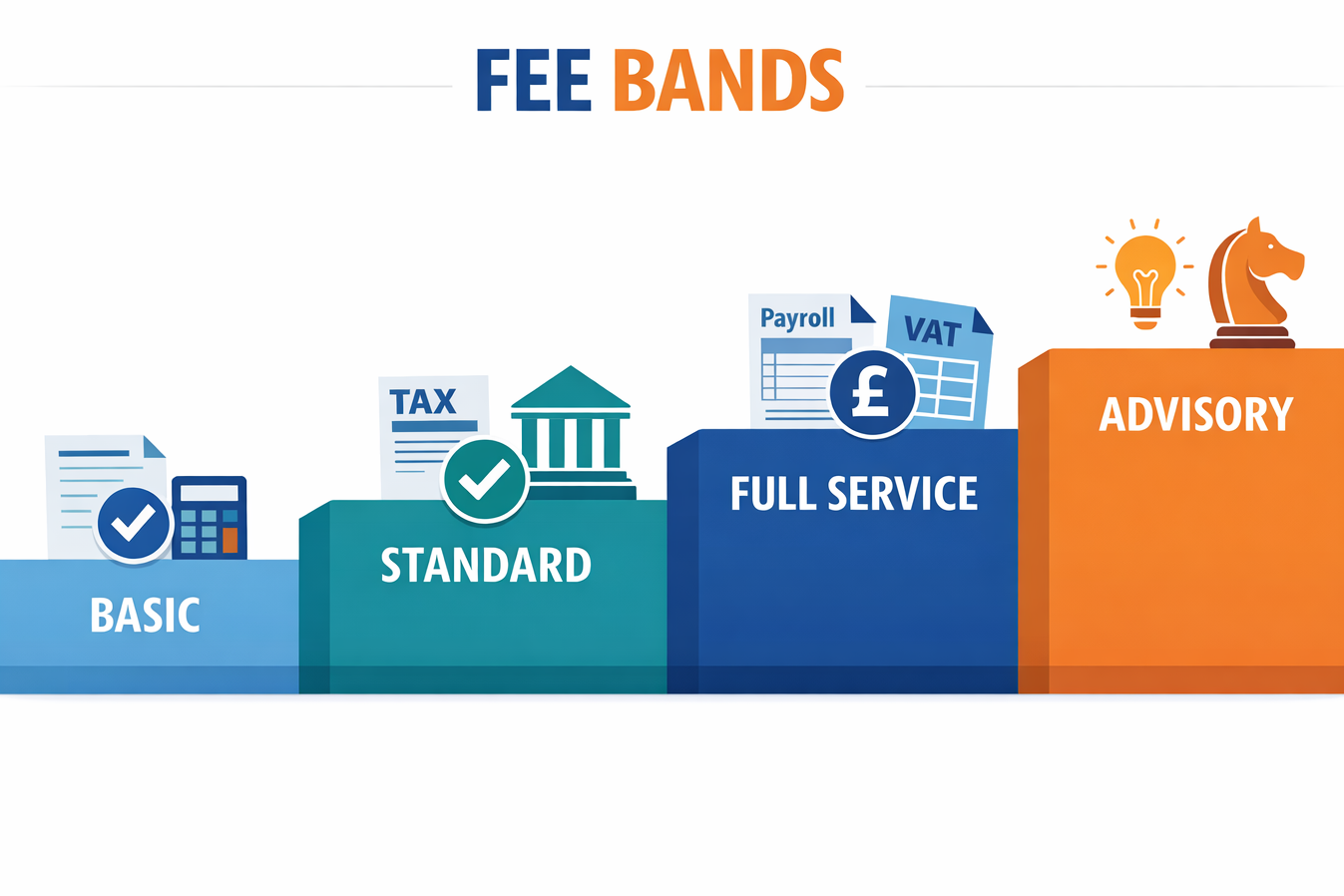
Typically included in a standard limited company package:
- Preparation and filing of annual statutory accounts
- Corporation Tax return (CT600) submitted to HMRC
- Confirmation Statement for Companies House
- Basic director self-assessment (sometimes — always ask specifically)
- General correspondence with HMRC if something minor pops up
Typically charged as extras — and this is where budgets get blown:
- Payroll management and Real Time Information (RTI) filings
- VAT return preparation and submission (quarterly or monthly)
- Additional director self-assessment tax returns
- Auto-enrolment setup and ongoing pension compliance
- Bookkeeping (often quoted separately — more on this shortly)
- CIS claims and refunds for construction businesses
- Business advisory or growth planning work
- HMRC investigation support
That last one catches people off guard every time. If HMRC opens a formal enquiry into your company, the time required from your accountant can escalate dramatically. According to GOV.UK guidance on HMRC investigations, enquiries can take months and require substantial documentation. Some firms offer investigation insurance as an add-on. Ask about it.
How Limited Company Accounting Fees Are Structured
Accountants price their services in a few distinct ways, and the structure matters as much as the headline number when working out the true cost of a limited company accountant.
Fixed monthly retainer — probably the most popular model for limited companies. You pay a set amount each month and know exactly what’s covered. Good for cashflow planning. Less good if something falls outside the package and you suddenly face an hourly rate you weren’t expecting.
Annual fee (upfront or in instalments) — structurally similar to the retainer, just packaged differently. Some accountants prefer this for smaller clients with predictable needs.
Hourly rate — still common for one-off work or specialist advice. Rates for a qualified accountant in London typically run from £100 to £300+ per hour, depending on seniority and firm size. A senior partner at a large practice? More. A competent sole practitioner? Often considerably less.
Value-based pricing — increasingly common among modern, advisory-focused firms. They price based on the value they deliver — tax savings, better business decisions, time freed up — rather than hours clocked. Harder to compare directly, but potentially excellent value when they actually deliver on it.
Geography: Why Location Changes What You Pay for a Limited Company Accountant
A limited company owner in central London will generally pay more for equivalent services than someone based in, say, Staffordshire. This isn’t about prestige — it’s overhead costs, competition dynamics, and the sheer concentration of complex businesses in cities.
London firms typically charge 20–40% more than the national average for comparable work. That said, South West London occupies an interesting middle ground — accessible, well-qualified firms with a mix of regional and city-scale pricing.
If you’re based in or near London and looking for competitive but genuinely experienced help, Ask Accountant (178 Merton High St, London SW19 1AY) offers full-service limited company accounting without the premium price tag of a central London postcode. They cover everything from bookkeeping through to corporate tax planning — a genuinely rounded offering.
Cost of Accountant for a Limited Company: Service-by-Service Breakdown
| Service | Typical Annual Cost (UK) | London Premium (approx.) | Notes |
|---|---|---|---|
| Annual accounts + CT600 only | £600 – £1,200 | £900 – £1,800 | Bare minimum — no payroll, no VAT. |
| Accounts + CT600 + VAT returns (quarterly) | £1,200 – £2,500 | £1,800 – £3,500 | Common for actively trading companies |
| Full package inc. payroll + bookkeeping | £2,500 – £5,000 | £3,500 – £7,000 | Depends heavily on employee count and transaction volume |
| Premium: advisory + full compliance | £5,000 – £15,000+ | £7,000 – £20,000+ | Business growth planning, tax advisory, strategic finance included |
| Bookkeeping only (outsourced) | £50 – £200/month | £80 – £300/month | Often quoted separately from main accountancy fee |
Figures are approximate ranges for 2025–26. Your actual quote will vary based on turnover, transaction volume, complexity, and provider.
The Bookkeeping Trap That Catches Most New Directors
Here’s something that comes up repeatedly with new limited company owners: they receive a competitive quote for accounts and compliance, feel good about the number, then discover six months in that their bookkeeping is so disorganised that the accountant has charged three or four hours of clean-up time on top.
The lesson? Bookkeeping and accounting are not the same thing. Bookkeeping is the ongoing recording of transactions. Accounting is the interpretation, structuring, and filing of what those records show. Many firms offer both — but they’re often quoted separately, and that second number can sting.
If you’re keeping your own records using Xero, QuickBooks, or Sage, let your accountant know upfront. Tidy, reconciled books going into year-end can genuinely reduce your bill. If you’re not (and plenty of busy directors simply aren’t), factor bookkeeping services into your total budget from the start rather than discovering the cost later.
According to ICAEW guidance on accounting records, limited companies are legally required to maintain adequate accounting records — another reason clean bookkeeping isn’t optional.
Is That Quote Actually Good Value? How to Tell
This is the real question underneath the question, and lower doesn’t automatically mean worse. What you’re trying to assess is the value-to-cost ratio — which is slightly more work than just comparing two headline numbers.
Things to weigh up:
- What’s actually in the package? Get a written breakdown, not a vague summary.
- Who will handle your account day-to-day? Partner-led firms sound impressive until you find out a junior is doing the actual work.
- Are they proactive or reactive? Will they flag tax planning opportunities throughout the year, or simply file what’s in front of them at year-end?
- What’s their experience with your sector? An accountant who mainly works with construction contractors may not be the ideal pick for a SaaS business.
- How do they communicate? Email only? Phone calls welcome? In-person meetings available? This matters more than most people anticipate.
⚠️ A note on cheap quotes: The lowest price in the room sometimes means corners get cut — rushed accounts, missed deadlines, or boilerplate advice that doesn’t account for your actual situation. HMRC penalties for late Corporation Tax returns start at £100 and escalate from there. A missed deadline can easily wipe out whatever you saved on fees. See the HMRC corporate tax penalties guide for the full picture.
How Company Turnover Affects the Cost of a Limited Company Accountant
There’s a fairly direct relationship between your company’s revenue and what accounting fees are likely to run. Higher turnover usually means more transactions, greater complexity, and more work overall.
| Annual Turnover | Typical Annual Fee (UK) | What’s Usually Expected at This Level |
|---|---|---|
| Under £50k | £600 – £1,500/yr | Accounts, CT600, basic compliance. Often 1 director. |
| £50k – £200k | £1,200 – £3,000/yr | VAT likely involved. Possibly payroll. Bookkeeping support. |
| £200k – £1m | £2,500 – £7,000/yr | Multiple employees, complex VAT, tax planning becomes important |
| £1m+ | £6,000 – £20,000+/yr | Full advisory relationship, management accounts, strategic finance |
Note: A high-turnover cash business with messy records can cost significantly more than a consultant with clean cloud accounting — even at the same revenue level. Records quality matters.
The Hidden Value: What Proper Tax Advice Actually Saves
There’s a version of the limited company accountant cost conversation that most people miss entirely — the part where proactive advice saves multiples of what it costs.
An accountant who simply files your accounts might charge £800. An accountant who notices you’ve been drawing salary inefficiently, haven’t extracted dividends at the optimal rate, missed an R&D tax credit, or could benefit from restructuring your director’s loan — that person might charge £2,200 and save you £9,000.
The tax advisory solutions that good firms offer aren’t a luxury. For growing limited companies, they’re often the difference between a tax bill that stings and one that’s been sensibly managed throughout the year. Business growth planning built into your accountancy relationship compounds this effect over time.
When Paying More for a Limited Company Accountant Makes Financial Sense
There’s a temptation in the early years to find the cheapest possible accountant and reassess when revenues grow. Understandable — but not always the wisest play.
If your limited company involves any of the following, paying for a higher-tier service from the outset often saves money downstream:
- Multiple shareholders with different tax positions and dividend strategies
- Property within or connected to the business
- Director/employee share schemes (EMI options, for example)
- R&D activities that might qualify for tax credits
- International trade or overseas clients
- Inheritance and succession considerations — the interaction between business assets and inheritance tax planning is something to address early, not after the fact
Getting this right from the start costs more. Getting it wrong and unravelling it later costs considerably more, sometimes with penalties attached.
Cost of Accountant for a Limited Company: What to Ask Before You Sign

Before committing to any accountant, these questions will separate the sharp from the merely adequate:
- What exactly is included in this fee? (Get it written down.)
- What would trigger additional charges, and at what rate?
- Who specifically will handle my accounts day-to-day?
- How do you communicate with clients, and how quickly do you respond?
- Are you familiar with businesses in my sector?
- What accounting software do you work with — and can I have live access to my data?
- What’s your approach to tax planning — proactive or reactive?
- What happens if HMRC contacts me or opens a formal investigation?
That last question matters more than most people realise. See the HMRC tax investigations guide for a clear picture of what an enquiry actually involves — and why having the right accountant in your corner makes a difference. For more detail on how HMRC conducts enquiries, GOV.UK’s compliance checks guidance is worth reading.
How to Reduce Your Limited Company Accountant Fees
Yes, this is possible. Not by hunting for whoever quotes the lowest number and hoping for the best — but by actively reducing the amount of work your accountant has to do.
- Use cloud accounting software (Xero, QuickBooks, FreeAgent) and keep it reconciled monthly. Clean data means fewer billable hours at year-end. Why cloud accounting matters for exactly this reason.
- Keep personal and business finances strictly separate. Untangling the two at year-end is one of the most avoidable time-wasters in small company accounting.
- Respond to information requests promptly. Chasing clients for documents takes time — and some firms bill for it.
- Ask your accountant what you could do differently. Most good accountants will tell you, because it makes their job easier too.
Frequently Asked Questions: Cost of Accountant for a Limited Company
How much does it cost to hire an accountant for a limited company in the UK?
For a basic one-director company with clean records, expect to pay between £600 and £1,500 per year for annual accounts and Corporation Tax filing. Once VAT returns, payroll, and bookkeeping are added, £2,500–£5,000 is a more realistic range for most small limited companies.
Do I legally need an accountant for my limited company?
No — there’s no legal requirement. However, limited companies have significantly more complex filing obligations than sole traders: statutory accounts must be prepared in a specific format, Corporation Tax returns filed with HMRC, and annual filings made to Companies House. Most directors find professional help reduces both errors and stress considerably.
Are accountant fees tax deductible for a limited company?
Yes. Accountancy fees paid for legitimate business purposes are an allowable expense against Corporation Tax. This means part of your accountant’s fee is effectively subsidised by reduced tax — worth factoring into the real net cost when comparing quotes.
What’s the difference between a bookkeeper and an accountant for a limited company?
A bookkeeper records your day-to-day financial transactions. An accountant interprets those records, prepares formal statutory accounts, handles tax compliance, and provides strategic advice. Many small businesses need both. Understanding the distinction between bookkeeping and accounting helps avoid budgeting surprises.
Can I use an online accountant to reduce the cost of accounting for my limited company?
Online accountancy firms typically charge £50–£150/month because they operate at volume with software-driven processes. They suit very simple businesses well. The trade-off is usually reduced personalisation and limited capacity for anything complex or unusual. For businesses with multiple shareholders, property, or sector-specific needs, a local accountant with real experience in your area is often worth the premium. Find out more about choosing the right accountant.
Should a director’s self-assessment be included in the company accountant fee?
Not automatically — and this is a very common source of billing surprises. Directors receive dividends and salary, which means they require a personal Self Assessment return. Whether this is bundled into your company package or charged separately varies by firm. Always confirm in writing upfront.
What happens if I switch accountants mid-year?
Switching is perfectly normal and usually straightforward. Your new accountant requests clearance letters and handover documentation from the outgoing firm. Timing matters — switching right around your company year-end is logistically messy. Mid-year transitions tend to be far cleaner. How to find a good accountant near you covers this in more detail.
The Bottom Line on Limited Company Accountant Costs
The cost of an accountant for a limited company isn’t a fixed figure — it’s a range shaped by the complexity of your business, the services you actually need, where you’re based, and most critically, whether the accountant you hire delivers genuine value or merely goes through the motions.
A poor cheap accountant can cost you more in missed deadlines, HMRC penalties, and avoidable tax than a good one charges in fees. That’s not a throwaway line — it’s a pattern that plays out repeatedly when businesses switch providers after something has gone wrong.
If you want to know whether your current fees are reasonable, or whether you’re getting everything a limited company at your stage actually needs, Ask Accountant is worth speaking to. They can be reached on +44(0)20 8543 1991 or visited at 178 Merton High St, London SW19 1AY. The range of services they offer — from small business accounting and bookkeeping to business advisory and tax advisory solutions — means clients aren’t piecing together a compliance picture from three different firms.
The question isn’t really “how much does a limited company accountant cost?” The sharper question is: what does it cost not to have the right one?